

Imagine your body is a kingdom, constantly under threat from invading germs like viruses and bacteria. To protect this kingdom, you have a highly organized army: your immune system.
Within this army are elite soldiers known as antibodies, which are trained to seek and neutralize specific threats.
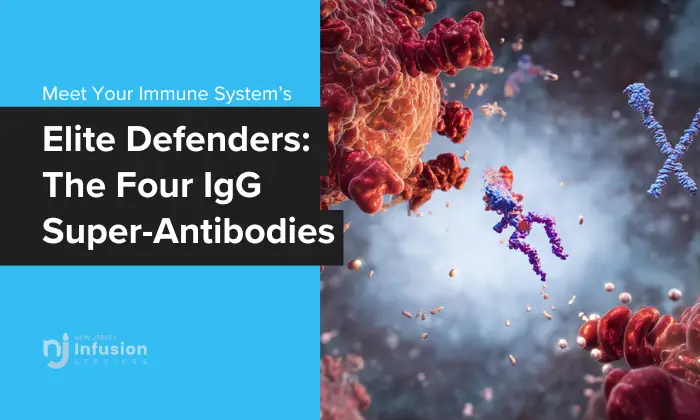
Among the most important of these soldiers is a special forces unit called Immunoglobulin G, or IgG. But this isn’t just one type of soldier—it’s a team of four distinct specialists, each with a unique skill set for defending you.
Let’s introduce you to each of these four elite defenders and explain their critical roles in keeping you safe.
The IgG Special Forces Unit: Meet the Team
There are four types of IgG defenders, officially called subclasses. Each is designed to fight different kinds of germs, ensuring your body has the right tool for any job. Let’s meet the team: IgG1, IgG2, IgG3, and IgG4.
IgG1: The All-Around Champion
IgG1 is the most common and abundant defender on the team, making up about 60-70% of all your IgG forces. It serves as the primary warrior against protein-based invaders, such as viruses and the toxins produced by bacteria.
This antibody is the star player of the “secondary immune response”—the powerful, targeted attack your body launches after it has already encountered a germ once before.
Superpowers Explained:
- Opsonization: IgG1’s first superpower is acting like a homing beacon. It “tags” invaders by coating their surface, essentially painting a target on them. This makes it easy for other immune cells to find, eat, and destroy the enemy.
- Complement Activation: Its second superpower is calling in an “air strike.” IgG1 can activate a powerful cascade of proteins called the complement system, which works to kill invaders directly.
Without its All-Around Champion, the immune army’s front line is severely weakened, leaving the body vulnerable to a vast range of common invaders it would normally defeat with ease.
IgG2: The Specialist for Tricky Germs
IgG2 is the second most common defender, making up about 20-30% of the team. While IgG1 is a generalist, IgG2 is a highly trained specialist with a very specific mission: fighting “encapsulated bacteria.”
These are tricky germs that hide from the immune system by wearing a slippery “sugar-coating” (a polysaccharide capsule). IgG2 is critical for defeating these stealthy enemies.
Key Targets:
- Streptococcus pneumoniae (a common cause of pneumonia)
- Haemophilus influenzae (can cause ear and respiratory infections)
- Neisseria meningitidis (a cause of meningitis)
- Streptococcus pyogenes (causes strep throat and skin infections)
Superpowers Explained: While its “air strike” (complement activation) power is weaker than IgG1’s, its main skill is grabbing onto these slippery sugar coatings. This allows other immune cells to get a grip on the germs and clear them out.
A deficiency in this specialist is like firing a security guard who knows how to spot intruders in disguise.
Without IgG2, these sugar-coated bacteria can repeatedly invade, leading to chronic and recurrent infections of the sinuses and lungs (a condition known as sinopulmonary infections), such as pneumonia and chronic bronchitis.
IgG3: The Rapid Response Unit
IgG3 is a less common but highly potent defender, accounting for only about 7-8% of the IgG forces. Its primary mission is to act as a fast and powerful first responder, particularly against the same protein invaders that IgG1 targets.
Think of IgG3 as the fast-acting sprinter of the team, delivering a powerful blow early in the fight, while IgG1 is the endurance runner, providing sustained, long-term defense and memory.
Superpowers Explained: IgG3’s greatest strength is being one of the team’s most powerful activators of the complement “air strike.” Its ability to rapidly trigger this system makes it a formidable weapon early in an infection.
Unique Trait: Unlike other IgG members, IgG3 has a much shorter lifespan (a half-life of 7 days compared to 21 for IgG1).
This means IgG3 is a short-burst defender that gets used up and cleared from the body three times faster than its long-lasting counterpart, requiring constant production during an ongoing infection.
A lack of IgG3 can weaken the body’s initial, rapid-fire response, particularly its ability to destroy certain types of bacteria, like gram-negative organisms, using the powerful complement system.
IgG4: The Immune System’s Diplomat
The rarest defender, IgG4, makes up only 3-4% of total IgG. Its role is completely different from the others. Instead of attacking, IgG4’s job is to act as a peacekeeper, promoting tolerance and calming the immune system down.
When It’s Used: IgG4 is typically produced during long-term or chronic exposure to something, like in a persistent infection or in response to allergens.
Superpowers Explained: This antibody is poorly inflammatory. It works to prevent the other, more aggressive IgG defenders from overreacting and causing unnecessary damage.
A deficiency of IgG4 by itself rarely causes problems. However, its absence can worsen the risk of infection if another key defender, like IgG2, is also missing.
Now that you’ve met each defender individually, let’s compare their key features side-by-side in a mission briefing.
Mission Briefing: Comparing the IgG Defenders
| Defender | Nickname | Abundance (Approx. %) | Primary Target / Mission | Key Superpower |
| IgG1 | The All-Around Champion | 60–70% | Viruses and bacterial toxins (protein antigens) | Powerful “tagging” (opsonization) and “air strikes” (complement) |
| IgG2 | The Specialist for Tricky Germs | 20–30% | Bacteria with slippery “sugar coats” (polysaccharides) | Grabbing onto hard-to-catch encapsulated bacteria |
| IgG3 | The Rapid Response Unit | 7–8% | Viruses and bacterial toxins (protein antigens) | Extremely fast and powerful “air strikes” (complement) |
| IgG4 | The Diplomat | 3–4% | Chronic antigen exposure | Calming the immune system and promoting tolerance |
This incredible specialization shows why having a full team of defenders is so important for staying healthy.
Conclusion: A Team of Specialists
The Immunoglobulin G (IgG) family is not a single entity but a sophisticated team of four highly specialized defenders.
Each member has a distinct role tailored to combat specific threats, ensuring your immune system is prepared for any challenge.
This division of labor is the genius of the immune system.
It ensures there is a powerful and fast response (IgG3), a durable and versatile memory (IgG1), a tool for highly specific threats (IgG2), and a mechanism to ensure all this power doesn’t cause self-harm (IgG4).
It is this precise and coordinated teamwork that allows your body to defend itself against an ever-changing world of microscopic threats.