Your Infusion. Your Home. Your Life Back.

Every few weeks, people receiving infusion therapy at medical facilities make the same exhausting trip. The drive. The waiting room full of strangers—some visibly sick. The hours in a clinical chair, wondering if the person coughing nearby will send their compromised immune system into crisis.

There’s a better way.

Infection Protection

The Safest Place for Your Infusion Isn't a Medical Facility. It's Your Home.

If you’re receiving IVIG for immunodeficiency, your body already struggles to fight infections that healthy people shrug off. If you’re on infliximab for Crohn’s, colitis, or rheumatoid arthritis, your medication deliberately suppresses immune function—leaving you vulnerable to every pathogen circulating in that crowded infusion center.
Here’s what the clinics don’t advertise:
Your home isn’t sterile. But you know its risks. You control its surfaces. And you’re not sharing air with a waiting room full of unknowns.

Clinical Excellence

A Nurse Who Knows Your Veins, Your Patterns, Your History.

In a busy infusion center, your nurse might be managing four, five, even six patients simultaneously. They’re checking pumps, answering call lights, documenting on multiple charts. Your infusion is one task among many.
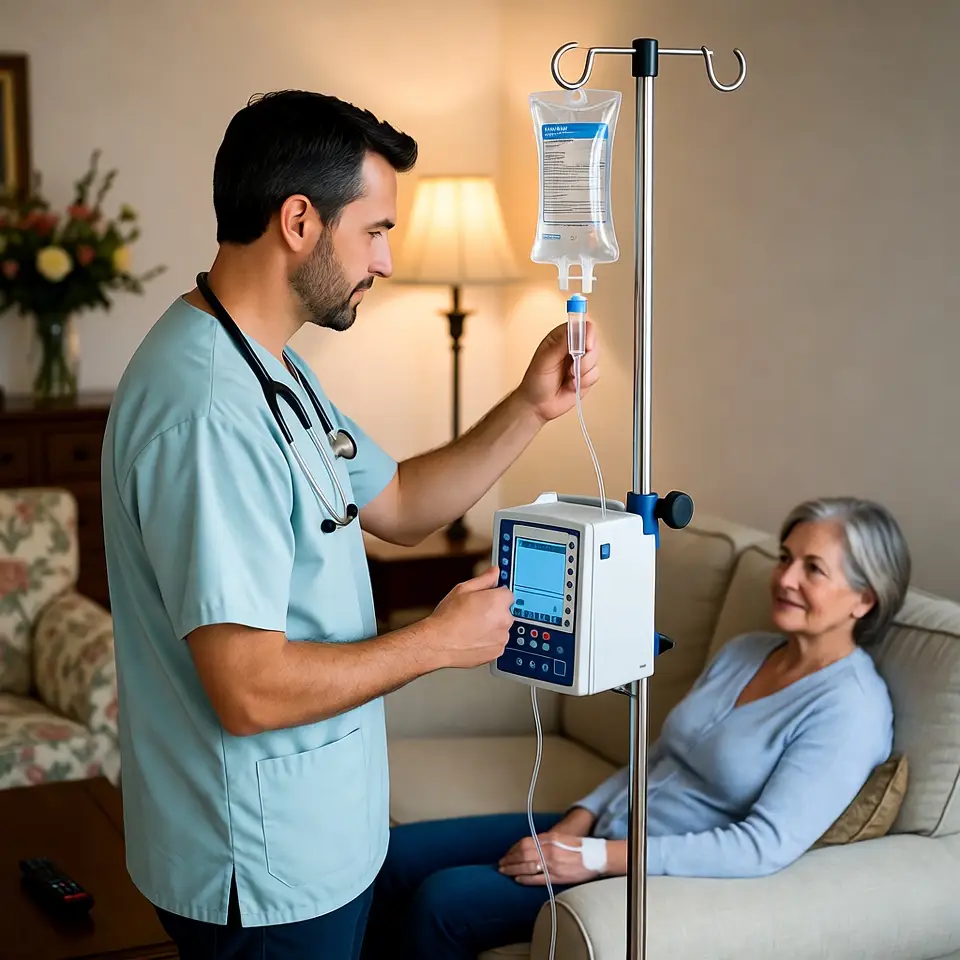
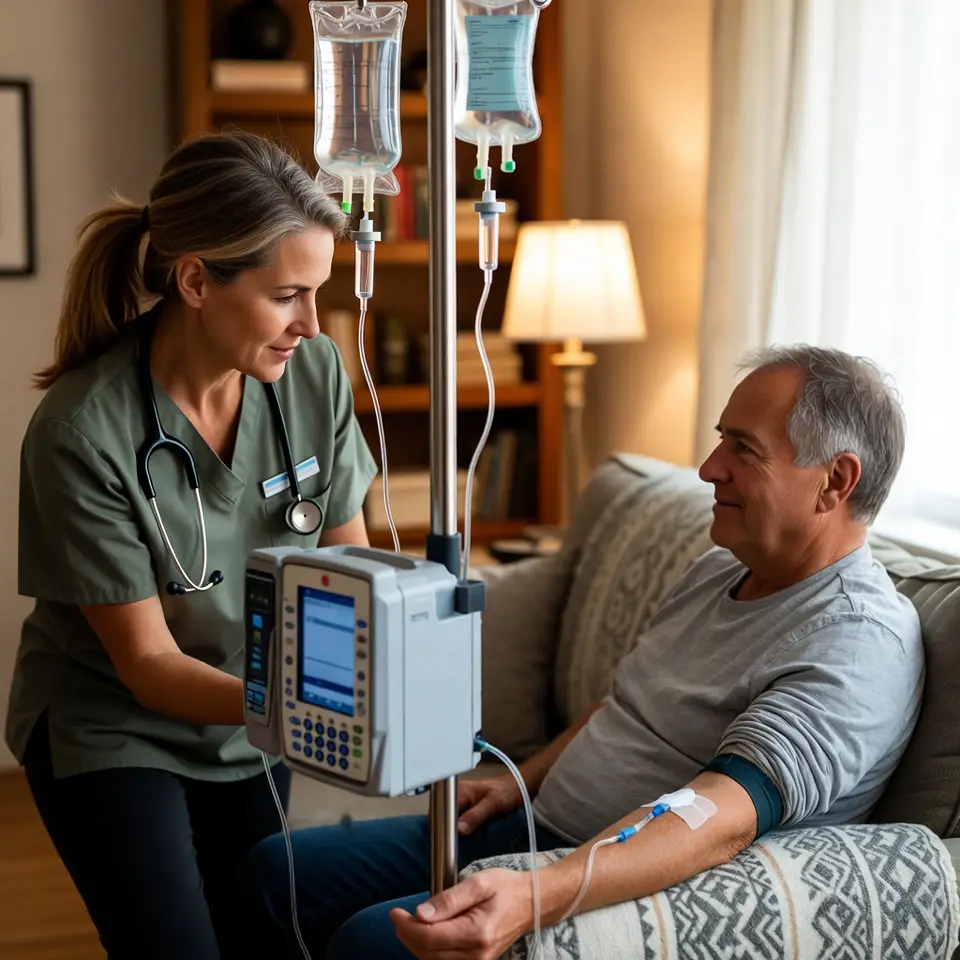
At home, the math changes completely. One nurse. One patient. The entire visit.

Your Life, Your Schedule

Four Hours for Treatment Shouldn't Cost You Eight Hours of Your Day.

You know the real math of an infusion center appointment. The drive—sometimes an hour or more. Parking. Check-in. The waiting room, where “your appointment time” means “when we’ll start thinking about you.” The infusion itself. Post-infusion observation in a clinical chair when all you want is your own couch.
A four-hour infusion becomes a six-hour ordeal. A full day, gone.

Now imagine this instead:

Your home isn’t sterile. But you know its risks. You control its surfaces. And you’re not sharing air with a waiting room full of unknowns.

The Invisible Burden Lifted

Treatment That Fits Into Your Life Instead of Consuming It.

There’s a weight that comes with chronic illness beyond the physical symptoms. It’s the constant scheduling around medical appointments. The anxiety that builds as infusion day approaches. The subtle erosion of identity as “patient” slowly overtakes every other role you hold.

Infusion is an effective treatment, not a cure. But home infusion lifts something that facility-based care imposes:

Seamless Coordination

One Referral. Everything Else Handled.

Getting diagnosed was hard. Finding the right specialist was hard. Deciding on treatment was hard.
What happens next shouldn’t be.
Your doctor writes one referral. You receive a call to schedule. Your nurse arrives at your door.
Everything between those moments? Handled.

Better Adherence, Better Outcomes

The Convenience Isn't Just Nice. It's Medically Necessary.

Here’s what the research shows: patients who face fewer barriers to treatment stay on treatment longer. And for your condition, consistency isn’t optional.
The convenience of home infusion isn’t separate from the medicine. It is the medicine, delivered in a way that actually gets used.

Your Treatment. Transformed.

Picture your next infusion. Not in a waiting room, watching the clock. Not sharing space with sick strangers. Not wondering when your nurse will have a moment for you.
Instead: your living room. Your nurse, focused entirely on you. Your schedule, your comfort, your control.
The same physician-quality care. The same medications. The same clinical standards.
Without everything that made infusion days something to dread.